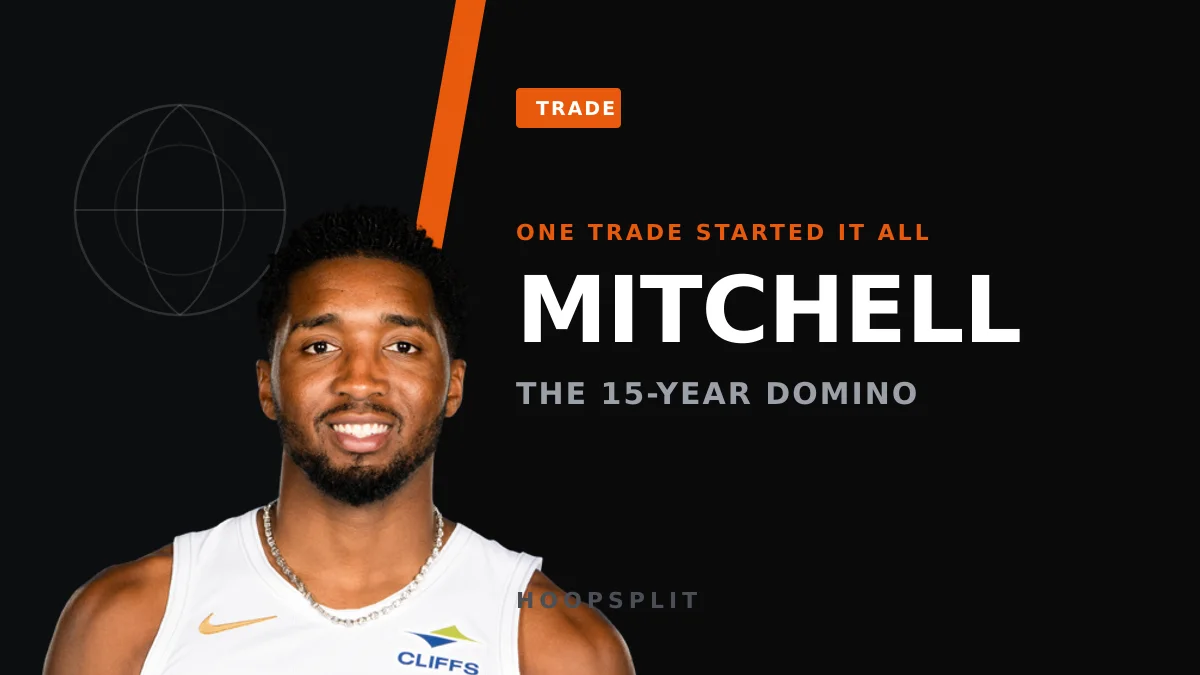
How a 2011 Mo Williams Trade Built Donovan Mitchell's Cavaliers
A 15-year trade chain from Baron Davis to Kyrie Irving to Collin Sexton delivered Mitchell — a 44.4 fantasy-point guard — to Cleveland.
Down just 3.1 FPTS over his last 5 — an elite guard at a soft price.
- Mitchell: 27.9 pts, 5.7 ast, 44.4 FPTS/G in 2025-26
- Cavs traded Mo Williams in Feb 2011 to start the chain
- The Baron Davis pick became No. 1 overall: Kyrie Irving
- Cleveland flipped Sexton + 3 firsts + 2 swaps for Mitchell
- Mitchell ranks #12 overall, #6 among guards in our model
Donovan Mitchell put up 27.9 points, 4.5 rebounds and 5.7 assists across 70 games last season (2025-26), good for 44.4 fantasy points per game — a top-12 line that anchors the Cleveland Cavaliers. But the wild part isn't the stat sheet. It's how he got to Cleveland in the first place.
The trail runs back exactly 15 years. In February 2011, the Cavs shipped Mo Williams and Jamario Moon to the Clippers for the leftovers of Baron Davis and a 2011 first-round pick. That pick hit at No. 1 overall. Cleveland used it on Kyrie Irving. Everything after that is a chain of dominoes falling in the same direction.
From Kyrie to Sexton to Mitchell
Irving spent six seasons in Cleveland, helped lure LeBron James back and won the 2016 title before forcing his way to Boston in 2017. The return package included a Brooklyn first that the Cavs eventually cashed as the No. 8 pick in 2018 — Collin Sexton. That draft slot is the load-bearing beam of this whole story.
Sexton became the centerpiece of the Mitchell deal. In 2022, Cleveland packaged Sexton, Lauri Markkanen, Ochai Agbaji, three first-rounders and two pick swaps to Utah for Mitchell. And Markkanen himself had only landed in Cleveland via a 2021 trade involving Larry Nance Jr. — who came from the Isaiah Thomas leg of the original Kyrie haul. It's turtles all the way down.
The knock-on effects didn't stop with the starting backcourt. The same tree of assets from the Thomas and Jae Crowder deals helped Cleveland absorb Jarrett Allen's contract in the three-team James Harden trade in 2021. Add it up and moving on from Mo Williams and Jamario Moon effectively built 40 percent of Cleveland's current starting five.
Sexton, for his part, is now in Los Angeles. He posted 15.4 points, 3.3 assists and 24.6 fantasy points per game across 68 games for the Lakers last season (2025-26), and he's ranked #145 overall in our model — a deep-league name rather than a difference-maker.
The Fantasy Fallout
Mitchell is the obvious winner of this history lesson, and the numbers back it up. He sits at #12 overall (#6 among guards) in our current rankings, and his last five games of 2025-26 came in only 3.1 fantasy points below his season average — barely a blip for a player carrying a 44.4 FPTS/G workload. That's a genuine first-round anchor.
The 5.7 assists matter for category leagues, too. Mitchell isn't just a volume scorer; the added playmaking gives him a cleaner path to a top-tier line even on cold shooting nights. If a manager in your league is nervous about anything, that's your buy-low window.
Sexton is the tougher call. His 24.6 FPTS/G is startable in 14-team formats, and his last five games ran 9.9 fantasy points above his season average — a real, if late, uptick. Just don't overpay chasing that hot streak from a #145 asset whose role in L.A. can shift week to week.
The verdict: buy Mitchell wherever you can. Any dip in his price from a slow stretch is noise, not signal — you're getting a top-12 guard whose arrival in Cleveland took a 15-year trade odyssey to engineer. Hold Sexton in deep leagues, monitor the form, but keep expectations at flier level.