Kyrie Irving Says He's Cleared to Go — What That Means for Fantasy
Irving returns from a 19-month ACL recovery with zero movement restrictions. At 34, is he worth a draft-day gamble, or a watch-and-wait?
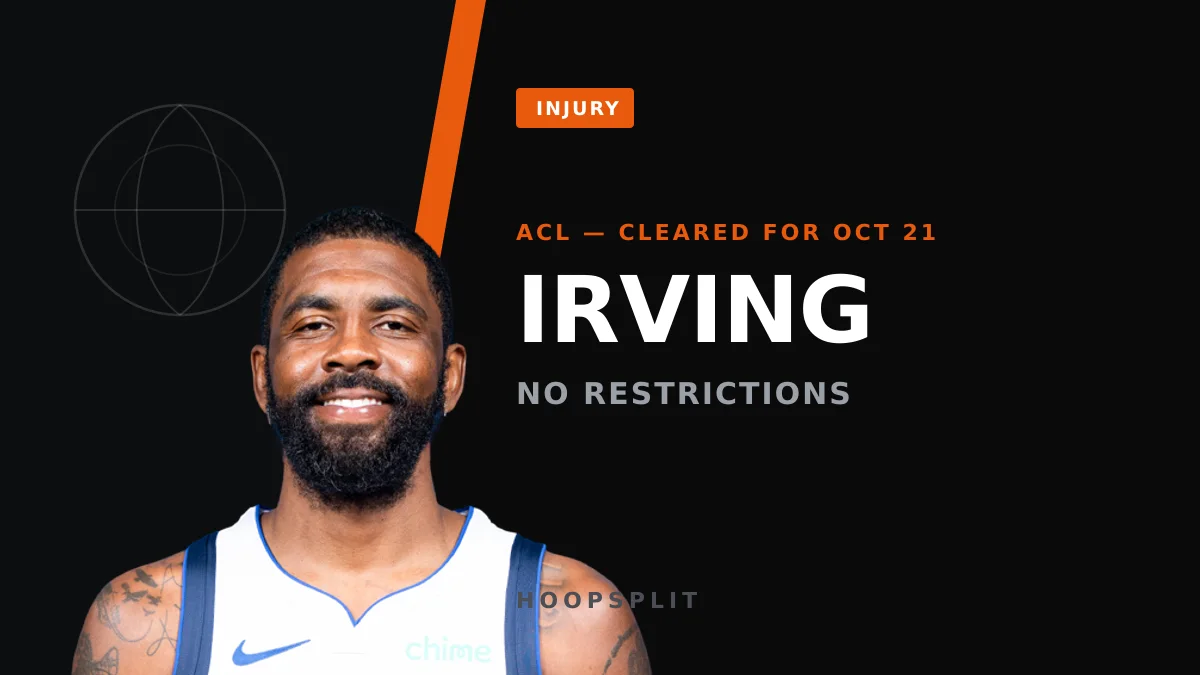
Cleared and confident, but a minutes cap and age 34 cloud Week 1.
- Irving says he's moving with no restriction (media day, Sept 26)
- Mavs open Oct 21 at Houston after ~19-month recovery
- 2024-25: 24.7 pts, 4.6 ast, 40.6 FPTS/G in 50 games
- Missed all of 2025-26; Dallas went 26-56
- Heat and Rockets floated as trade suitors (Sept 29)
Kyrie Irving walked into Mavericks media day on Sept. 26 and declared himself ready to go — no restriction of movement, fully working out and playing. That's the first time he'd spoken to reporters since tearing his left ACL, an injury that wiped out his entire age-33 season and turned Dallas into a 26-56 mess during Cooper Flagg's rookie year. Now 34, he's targeting the Oct. 21 opener at Houston, roughly 19 months after the tear.
The last time we saw a healthy Irving was 2024-25, and it was excellent: 24.7 points on north of 40% from three, 4.8 rebounds and 4.6 assists across 50 games, good for 40.6 fantasy points per game. The question isn't whether that version of Kyrie was fantasy gold — it was. The question is how much of it survives a lost season and a left knee that's been through the wringer.
What Dallas Actually Needs From Him
First-year coach Dusty May inherits a genuine dilemma. Does he cap Irving's minutes early to protect a surgically repaired knee, or let him play through it? That single decision will define Irving's fantasy ceiling for the opening month, and we probably won't have a clean answer until a week or two into the season.
There's a real debate about the mileage, too. Irving has missed more than 300 career games to injury, rest and personal matters. You can spin that two ways: either his body is weirdly fresh after sitting out all of 2025-26, or the accumulated damage makes him older than the calendar suggests. Both arguments are legitimate, which is exactly why he's a risk.
The optimistic framing is a near-replica of his 2024-25 line — something like 23 points on 39% from deep with four assists and four boards across 60 games. If Dallas gets that, they flirt with 40 wins and a play-in berth. If they get a re-aggravation instead, the rebuild around Flagg stalls and Irving becomes an albatross they couldn't move for a second straight deadline.
The Flagg Factor
This is where it gets interesting for roster builders. Flagg finished his rookie year at 21 points, 6.7 rebounds and 4.5 assists over 70 games — 39.8 fantasy points per game — and he enters his encore as our No. 34 overall player (#13 at his position) off a last-five stretch running 3.8 fantasy points above his season average. Irving's gravity and handle could pry open easy threes for Flagg and take him off the ball when needed.
If that chemistry clicks, both players win. Irving did exactly this trick earlier in his Dallas tenure alongside another young star, and Flagg has said the summer court time has already built a connection. A functional pairing lifts Flagg's scoring efficiency and keeps Irving's assist numbers honest — the kind of symbiosis fantasy managers should root for on draft night.
The Fantasy Fallout
The winners here are easy to name. Flagg is the safest Mavs asset on the board — healthy, trending up, and only more valuable if Irving draws defensive attention. If you can land him near his No. 34 rank, do it. And keep an eye on Anthony Davis in Washington, now our No. 13 overall player; his departure is part of why Dallas leaned so young, and his 44.2 fantasy points per game in 2025-26 (across just 20 games) reminds you how much production left the building.
Irving himself is the classic high-variance pick. He's our No. 29 overall player (#13 at the guard spot), carrying that 40.6 FPTS/G from 2024-25 as his baseline — but that number is two seasons old, pre-ACL, and assumes a minutes load May may not hand him. The trade noise doesn't help either: Fischer floated Miami and Houston as suitors as recently as Sept. 29, and a deal before the 2027 deadline would scramble his usage entirely.
The move: don't reach. Let someone else pay the healthy-Kyrie price in the middle rounds and grab him a tier later as a calculated upside swing. Watch his opening-week minutes like a hawk — if May lets the reins go and the knee holds, he's a weekly must-start. Until then, he's a watch, not a build-around.